What Is a Reefer Container?
How a reefer works
“Reefer” is shipping shorthand for refrigerated. The refrigeration unit is the container’s front end: on one common model, an aluminum-framed unit bolted on as the front wall, with the compressor, fans, controls and power cable reached from outside. The walls, roof and floor are filled with polyurethane-based insulation, which is why a reefer is smaller inside than a dry container.
The compressor pushes refrigerant through a condenser, where it gives up heat to the outside air, then through an expansion valve into the evaporator coil, where it takes heat from the air returning from the cargo. Fans send that chilled air back into the box low, along the floor. Standard reefers have a T-bar floor, rails with channels between them running from the unit to the doors, so the air travels under the load, rises through it and comes back to the unit near the ceiling. In a computer simulation of a fully loaded 40ft, that floor spread the cold through the load more evenly than a flat one.
A controller keeps the setpoint by choosing between cooling, holding and heating. For chilled settings, above +14 °F (−10 °C) or +23 °F (−5 °C), depending on how it’s configured, it regulates the air leaving the unit; for frozen settings, the air coming back from the cargo. Frost that builds up on the evaporator coil chokes the airflow, so the unit defrosts it from time to time with heaters under the coil. Depending on the model, it can also control humidity, let in outside air through an adjustable vent, and log temperatures in a built-in recorder that downloads to a USB drive.
What reefers are used for
At sea, reefers carry fruit and vegetables, fish, meat, dairy, frozen food, wine and pharmaceuticals. On land, they add cold storage without building any: a restaurant, grocer or food distributor that has outgrown its coolers, a farm at harvest, or a business keeping stock cold while its own cold room is repaired. A non-working reefer, whose unit no longer runs, keeps only its insulation, which suits dry goods and equipment that are better kept out of the heat.
How cold it gets
Is a reefer a freezer? Yes, and a refrigerator and a heater as well, all in one unit. Controllers on common units accept setpoints from about −31 °F or −40 °F up to +86 °F (−35 or −40 °C to +30 °C), and the new reefers listed here are rated to hold as low as −10 °F inside. A used unit’s real limits depend on its age and condition.
The setpoint and the temperature you get aren’t always the same. What the box holds also depends on the load, how often the doors open and how hot it is outside, so leave room for the air to move around the goods. Name the temperature you must hold in your request; ask each seller to name the unit fitted to the container.
Power on land
A reefer unit needs a three-phase supply of nominally 380 to 460 volts; in the US, that means a 460 V, 60 Hz circuit. Some have an autotransformer that lets them run on 190–230 V three-phase as well. None of this plugs into an ordinary single-phase outlet, the kind most homes have, so a working reefer needs an electrician’s look at the site before it’s ordered.
For a sense of the load, one common unit has a 25 A main breaker on 460 V, a compressor drawing about 13 A at full load, and a current limit set at 21 A by default, adjustable from 15 to 23 A; a lower limit trims the draw but also the cooling. Plugs and cables differ from unit to unit, so the electrician fits the receptacle to yours.
Where there’s no suitable supply, a reefer runs from a diesel generator set. Two common Carrier reefer gensets are rated around 15 kW at 460 V: one clips onto the front of the container, with a tank of about 130 gallons; the other hangs under a trailer chassis, with about 50. Put the voltage and phase you have in your request, and ask each seller for the unit’s exact requirements. Delivery and site checklist.
Reefer sizes and weights
The two sizes in the carrier and forwarder reefer specifications we used are the 20ft and the 40ft high cube, and those are the two listed here. Outside, each matches the dry container of its size. Inside, a reefer runs about 1½ ft shorter and 2½ in narrower, with less headroom: a 40ft high cube reefer holds about 2,390–2,400 cu ft, roughly 11% less than the 2,690 cu ft of a dry high cube. In European (EUR) pallets, a freight forwarder rates the 40ft high cube at up to 23 and the 20ft at 10, depending on pallet height and on leaving room for air.
| Measurement | 20ft reefer | 40ft high cube reefer |
|---|---|---|
| Outside (L × W × H) | 19′10½″ × 8′ × 8′6″ (6.06 × 2.44 × 2.59 m) | 40′ × 8′ × 9′6″ (12.19 × 2.44 × 2.90 m) |
| Inside (L × W × H) | about 17′10″ × 7′6″ × 7′1″– | about 38′ × 7′6″ × 7′11″– |
| Door opening (W × H) | about 7′6″ × 7′5″ (2.29 × 2.26 m) | about 7′6″ × 8′4″– |
| Inside volume | about 990– | about 2,390– |
| Empty weight (tare) | about 6,300– | about 9,480– |
| Max payload | about 60,560– | about 63,400– |
| Max gross weight | 67,200– | 74,960 lb (34,000 kg) |
Outside: ISO 668. Inside, door, volume and weights: the reefer specifications of two ocean carriers, given as non-contractual examples, and a seller’s 40ft high cube listing. The tare and max gross weight of each container are marked on its doors. Dry containers: shipping container dimensions.
Reefer, insulated or dry?
| Container | Holds a set temperature | Power | From |
|---|---|---|---|
| Working reefer | Yes, chilled or frozen | Three-phase, or a genset | $8,450 |
| Non-working reefer | No; its insulation only slows changes | None | $5,000 |
| Climate-controlled container | Yes, with an A/C that heats; not for chilled or frozen goods | Needed for the A/C | $10,030 |
| Used 20ft dry container | No; it follows the weather | None | $1,400 |
One term trips up buyers: a “non-operating reefer” (NOR), in shipping-line language, is a reefer sailing with its unit switched off and dry cargo inside, and the unit may be fine. A non-working reefer is a different thing: its unit doesn’t run, and it’s sold as insulated storage. When a listing says NOR, ask whether the unit cools.
What a reefer costs
With working machinery, used reefers start this week at $8,950 for a 20ft and $8,450 for a 40ft high cube; non-working boxes at $6,750 (20ft) and $5,000 (40ft high cube); new one-trip reefers at $27,000 (20ft) and $27,500 (40ft high cube). Used, the 40ft high cube starts lower than the 20ft this week, so compare both if either size works for you. New, you pay for machinery covered by its manufacturer’s warranty; used and working, the machinery carries whatever the seller guarantees, so compare that from quote to quote. On top of these starting prices, budget for delivery and sales tax, the electrical work or a genset, and the power to run it. How we set reefer prices.
Checking a used reefer
- It has to cool. Power a working reefer up before you accept it, and make sure the seller’s quote lets you refuse it if it doesn’t cool.
- Read the unit’s plate. On a Carrier unit, the model and serial number are on a plate on the back wall of the condenser section, the part you see from outside. Ask each seller for the brand and model before you accept, and check that its quote names them.
- Use the self-test. Units such as Carrier’s have a built-in pre-trip test, started from the keypad, that runs through the refrigeration system and records the result.
- Check the box itself. Doors that close and seal, walls and roof without holes, as with any used container; ask each seller how long it guarantees the box, and check that its quote says so.
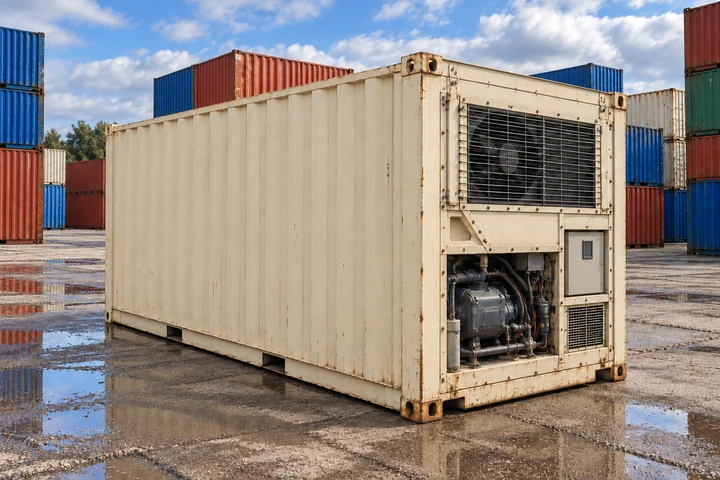 Illustrative image
20ft Refrigerated Container (Reefer) — Used
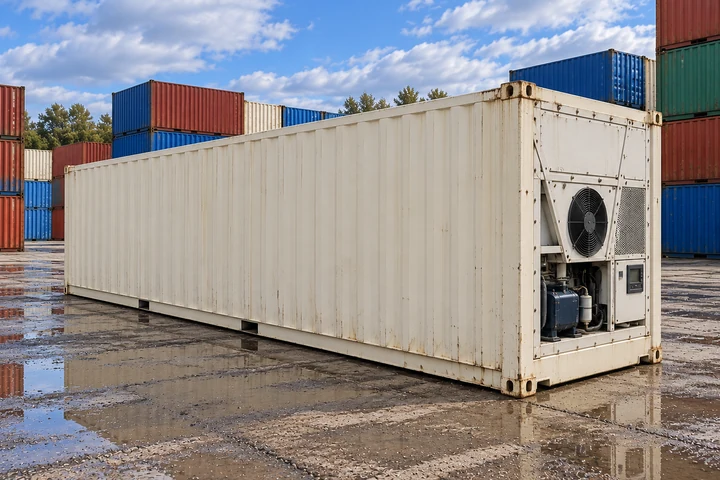 Illustrative image
40ft High Cube Refrigerated Container (Reefer) — Used
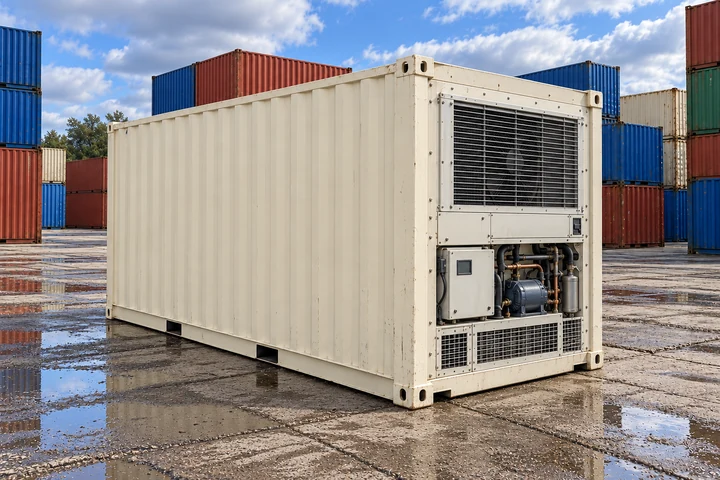 Illustrative image
20ft Refrigerated Container (Reefer) — New (One-Trip)
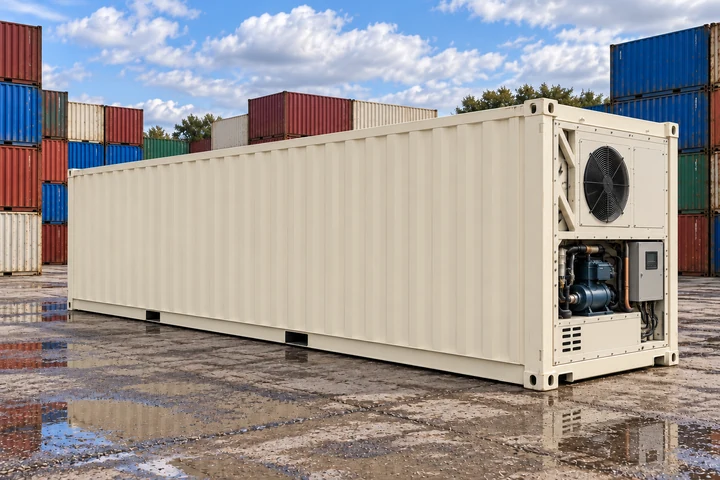 Illustrative image
40ft High Cube Refrigerated Container (Reefer) — New (One-Trip)
Frequently asked questions
Are there refrigerated shipping containers?
Yes, and shippers call them reefers. They’re ISO containers like dry ones, sold here in 20ft and 40ft high cube, with insulated walls, roof and floor and a refrigeration unit forming one end. Retired from ocean service or bought new, they’re sold for cold storage on land. Reefers for sale.
Can a reefer container keep things warm?
Yes. Besides cooling, the unit has electric heaters, and its controller moves between cooling, holding and heating to stay at the setpoint, so it holds temperature through cold weather too, as long as it has power.
Can you run a reefer container on a generator?
Yes, on a diesel generator set built for reefers or one your electrician confirms can carry the unit’s three-phase load. Two common Carrier reefer gensets, for example, are rated around 15 kW at 460 V, with 50 or 130 gallons of fuel on board.
How heavy is a 40ft reefer container, and how much can it hold?
Empty, a 40ft high cube reefer weighs 9,480–10,450 lb, insulation and unit included. It’s rated to carry 63,400–65,210 lb of cargo, up to a 74,960 lb maximum gross weight; its own tare and max gross weight are marked on the doors. By volume, 2,390–2,400 cu ft.
What are the dimensions of a 20ft refrigerated container?
Outside, the same as any 20ft: 19′10½″ × 8′ × 8′6″ (6.06 × 2.44 × 2.59 m). Inside, about 17′10″ long and 7′6″ wide, with 7′1″ to 7′5″ of headroom, and the doors open about 7′6″ wide by 7′5″ high. That leaves 990–1,010 cu ft of cold space.
Sources
How the unit works, its modes, defrost, options, power and current: the operations and service manual of the Carrier Transicold PrimeLINE, and Thermo King’s MP4000 controller specifications for its setpoint range. Air path and floor: a university patent on reefer design and a peer-reviewed airflow study of a loaded 40ft (CFD Letters, 2024). Sizes and weights: ISO 668 and two ocean carriers’ reefer specifications; pallets, loading and shipping uses: a freight forwarder’s 40ft reefer sheet; gensets: a container lessor’s spec sheet for Carrier’s clip-on and under-chassis models; uses on land: a US storage seller’s guide; non-operating reefers: two freight forwarders’ explanations. Prices: our weekly survey of public listings, Oct 21, 2026.